
The 2025 Nobel Prize in Economics was announced on October 13th local time.
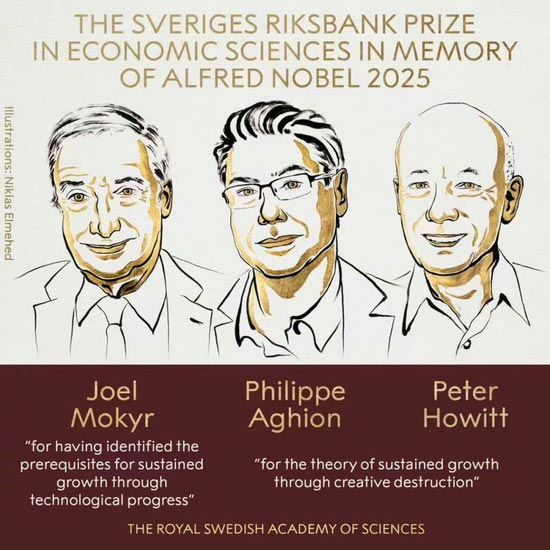
This year's Nobel Prize in Economics was awarded to Joel Mokyr, Philippe Aghion, and Peter Howitt for their "explanation of innovation-driven economic growth."
According to a statement released by the Royal Swedish Academy of Sciences, half of the prize went to American-Israeli economist Mokyr for "discovering the prerequisites for sustained growth through technological progress." The other half was awarded jointly to French economist Aghion and Canadian economist Howitt for their "theory of sustained growth through creative destruction." The Nobel Prize in Economics serves as both a bellwether for economic research and a response to major, cutting-edge global economic issues.
It is worth noting that from 1969 to 2025, the Nobel Prize in Economics has been awarded 57 times, with a total of 99 recipients. Of these, 73 have been Americans, representing nearly 74% of the total, far exceeding all other countries.
Of course, this statistic includes American-born laureates and those who later acquired U.S. citizenship.
A closer look at the data reveals that since 2000, with the exception of 2014, when the Nobel Prize in Economics was won solely by Frenchman Jean Tirole, every other year's laureate has included an American. The most discussed candidates each year are primarily American economists.
Why do American economists almost monopolize the Nobel Prize in Economics?
What's different about this year's winners?
The Nobel Prize in Economics is one of the world's highest honors in economic research.
Image source: Nobel Prize official website
Joel Mokyr received half of this year's Nobel Prize in Economics. Born in Leiden, the Netherlands, in 1946, he received his Ph.D. from Yale University in 1974. He is currently a professor at Northwestern University.
Mokyr has been teaching at Northwestern University since 1974. His research focuses on the historical connection between technological progress and the Industrial Revolution. He proposed the "culture of growth" theory, arguing that shifts in cultural values in 18th-century Europe drove the transformation of scientific knowledge into technology. He developed the concepts of "useful knowledge" and "industrial enlightenment," emphasizing the central role of the Enlightenment's ideological transformation in driving the British Industrial Revolution.
The other half was shared by Philippe Aghion and Peter Howitt.
Philippe Aghion, born in Paris, France, in 1956, received his Ph.D. from Harvard University in 1987. He is currently a professor at the Collège de France, INSEAD, and the London School of Economics and Political Science. Peter Howitt, born in Canada in 1946, received his Ph.D. from Northwestern University in 1973 and is currently a professor at Brown University.
The "Schumpeterian growth model," jointly developed by the two, has become a core text in mainstream macroeconomics. Their research proposes that innovation is the core driver of economic growth and argues that governments need to balance competition policies to address the contradictions inherent in the innovation process.
According to Cailian News Agency, the Nobel Prize Committee in Economic Sciences stated that the three laureates, in different ways, demonstrated how creative destruction creates conflict, which must be managed constructively. Otherwise, innovation will be hindered by established companies and interest groups, which could be disadvantaged.
"The laureates' work demonstrates that economic growth cannot be taken for granted. We must safeguard the mechanisms underlying creative destruction so that we do not slip back into stagnation," said John Hassler, Chair of the Nobel Prize Committee in Economic Sciences.
The three laureates' research provides a theoretical framework for policymakers and investors to understand how technological innovation drives long-term economic growth, which is of great significance for assessing the economic impact of science and technology investment and innovation policies.
This year's Nobel Prize in Economics once again focuses on research into economic growth theory, continuing the tradition of favoring macroeconomic research in previous Nobel Prizes.
Why Americans?
Why has the Nobel Prize in Economics become almost exclusively awarded to American scholars?
For one thing, this has a lot to do with the United States' economic position in the world.
Since the mid-20th century, the United States has consistently held a dominant position in the global economy, and its research in economic theory has been at the forefront of other countries. This unique economic environment has created indispensable conditions for the success of American economists, nurturing many renowned economists whose research is rooted in the broader American economic landscape of the time.
Of course, more importantly, the United States is widely recognized as the most developed in the field of economics, particularly in academic research and education.
The US economics education system is well-developed, offering a wide range of specialized fields from basic to cutting-edge, and is closely integrated with finance and policy research.
For those interested in studying economics, the United States boasts many of the world's top universities for economics research, such as the University of Chicago, Massachusetts Institute of Technology, Harvard University, Stanford University, Princeton University, Yale University, and the University of California, Berkeley. The majority of Nobel Prize winners in economics hail from this region.
Among them, the University of Chicago, MIT, and Harvard University rank in the top three, both in terms of the number of laureates and their influence. Many laureates received their doctorates or achieved their earliest scientific achievements at these three institutions.
"In the field of economics, the dominance of Americans or scholars working in American institutions is more obvious," said the late Alan Sanderson, professor of economics at the University of Chicago.