
Artistic conception of an "extraterrestrial messenger" discovered in the Chang'e-6 lunar soil
Another secret of the solar system's history has been revealed, hidden in the Chang'e-6 lunar soil. Scientists have identified remnants of CI-type meteorites, primarily found in the outer solar system's asteroid belt, in the lunar soil. This not only updates our understanding of the migration mechanisms of matter in the inner solar system but also provides new directions for future research on the distribution and evolution of lunar water resources. The results were published in the international academic journal Proceedings of the National Academy of Sciences of the United States of America (PNAS) in the early morning of October 21st.
Meteorites, known as "messengers of the solar system," are crucial for studying the formation and evolution of planets. However, due to the influence of Earth's atmosphere and geological activity, most meteorites are difficult to preserve intact. CI-type carbonaceous chondrites, in particular, account for less than 1% of Earth's meteorite record. The Moon, lacking an atmosphere and geological activity, serves as a "natural archive" for meteorite impact traces.
Under the guidance of Academician Xu Yigang and Researcher Lin Mang of the Guangzhou Institute of Geochemistry, Chinese Academy of Sciences, Associate Researcher Wang Jintuan and doctoral student Chen Zhiming conducted a detailed analysis of lunar soil samples brought back by Chang'e-6, identifying impact remnants from CI-type meteorites.
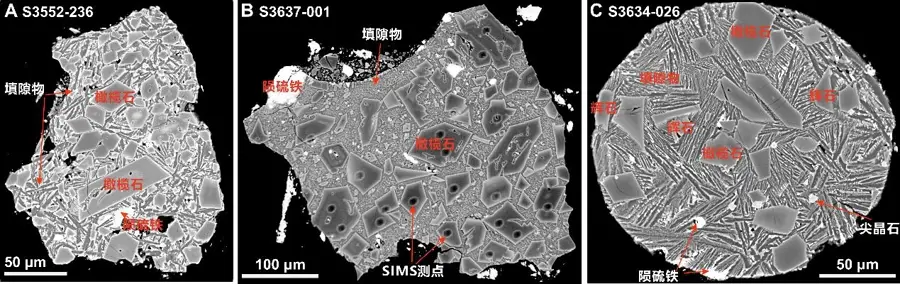
Impactor fragments identified in Chang'e-6 lunar soil
CI-type meteorites' parent asteroids are primarily found in the outer solar system's asteroid belt and are rich in volatile components such as water and organic matter. Through systematic analysis of these remnants, researchers propose that these fragments are the product of the CI-type carbonaceous chondrite parent body impacting the lunar surface, melting, and then rapidly cooling and crystallizing. Further analysis indicates that the proportion of these meteorites on the lunar surface is much higher than on Earth, suggesting that the impact contribution of carbonaceous meteorites to the Earth-Moon system may be significantly underestimated.
This discovery not only shows that material from the outer solar system can migrate into the inner solar system, but also has important implications for explaining the origin of water on the lunar surface. Researchers believe that the water with positive oxygen isotope characteristics previously detected in lunar samples is likely to have come from the impact contribution of such meteorites.