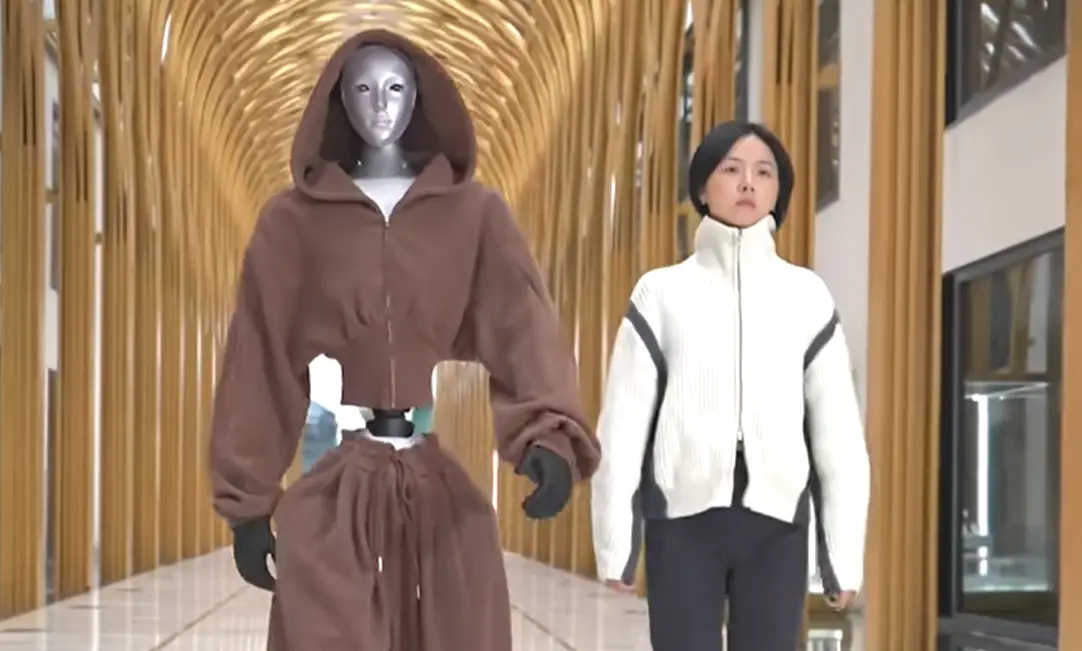
Unittree Robotics has another new product! On October 20th, YuShu released the H2 bionic humanoid robot, standing 180cm tall and weighing 70kg. Its overall form is even more lifelike.
YuShu founder and CEO Wang Xingxing retweeted the H2 video and said, "This is a brand new model, I hope you like it."
In YuShu's promotional video, the H2 demonstrates athletic skills ranging from ballet to martial arts and catwalk performances. These include challenging continuous spinning and side kicks, with no noticeable mechanical lag and naturally flowing movements, demonstrating flexible and stable motion control.
This is driven by technological advancements. The H2 is reportedly equipped with lidar and bionic cameras for 360-degree environmental perception, and its motion control algorithm can adjust its gait in real time to accommodate uneven surfaces.
Notably, unlike previous humanoid robots, the H2 also features a bionic face design for the first time, making its overall appearance more human-like. The company claims that the H2's product design concept is to provide safe and friendly service.
The H2's highly anthropomorphic design has reminded many netizens of the robot Sonny from the sci-fi film "I, Robot." Its silver-gray exterior and bionic face bear a striking resemblance to a human face, creating a bit of an "uncanny valley" effect.
It has 31 joint degrees of freedom, but it's not yet autonomous.
YuShu previously teased this product on August 19th. The poster featured a silhouette of a new robot, 180 cm tall, with the caption "31 joint DOF (6*2+3+7*2+2)," meaning it possesses 31 joint degrees of freedom.
Joint DOF refers to the number of dimensions in which a robot's joints can independently move and is a key metric for measuring a robot's mobility. Generally speaking, the more joint DOF, the greater the robot's flexibility and precision, enabling it to perform more complex tasks.
Industry analysts note that 31 joint DOF covers nearly all of the body's fine-grained movements. A typical configuration includes: 6×2 joints in the legs (for multi-directional movement of the hips, knees, and ankles), 7×2 joints in the arms (for redundant DOF obstacle avoidance and grasping), 3 joints in the waist (for twist/pitch), and 2 joints in the neck (for nodding/shaking).
Public data shows that Tesla's humanoid robot has 28 degrees of freedom in its joints, while Figure AI's newly released third-generation robot boasts a total of 42 degrees of freedom.
On September 26th, YuShu founder and CEO Wang Xingxing announced in a speech at the 4th Global Digital Trade Expo that the YuShu robot algorithm has undergone several iterations this year, and plans to release a 1.8-meter-tall humanoid robot in the second half of the year.
"YuShu recently updated its algorithm again, significantly improving the robot's stability. With the algorithm upgrade, the robot can theoretically perform various dance and martial arts moves," Wang Xingxing said.
Wang Xingxing has mentioned on multiple occasions that the purpose of robots performing dance and boxing is to demonstrate their capabilities and explore early commercialization, ultimately pushing them to perform tasks. He believes that the biggest bottleneck in current robot development lies in large-scale embodied intelligence models.
Whether the capabilities demonstrated in the H2 video are remotely controlled or autonomous has also sparked online interest. Given Wang Xingxing's repeated criticism of the lack of AI capabilities in robots, the industry believes this demonstration is likely a remote-controlled demonstration. This is still a far cry from the autonomous, omnipotent Sonny robots depicted in science fiction films.
Wang Xingxing previously believed that robots are still stuck at the stage of performing fixed actions and are unable to "work" autonomously. The next key milestone is enabling robots to respond to real-time commands and perform any action within their capabilities. This goal is expected to be achieved by the end of this year or the first half of next year.
"The real breakthrough will be enabling robots to autonomously understand commands and interact with the physical world in completely unfamiliar environments. This could happen by the end of next year or the year after," Wang Xingxing predicted.
YuShu's humanoid robots already account for 30% of its revenue.
YuShu currently has a diverse portfolio of humanoid robots, including the H1, G1, and R1. The H1 is YuShu's first full-size, general-purpose humanoid robot, released in August 2023. Like the H2, it stands 1.8 meters tall, but features a lightweight design, weighing only 47 kilograms. It was this robot that performed the handkerchief-throwing performance on the Spring Festival Gala.
Last May, YuShu released the G1, which stands 1.3 meters tall and weighs 35 kilograms. It has recently become YuShu's mainstay robot for boxing and fighting demonstrations at various exhibitions. The R1, released in July of this year, stands 1.2 meters tall and weighs approximately 25 kilograms. It was recently named one of Time Magazine's Best Inventions of 2025.
These robots also exhibit significant price differences. The H1 costs a whopping 650,000 yuan, the G1 99,000 yuan, and the R1 starts at 39,900 yuan. It can be said that YuShu has consistently driven down the price of its humanoid robots.
With the release of the H2, YuShu's humanoid robot product portfolio has become more comprehensive, but pricing for the H2 has not yet been announced. Some analysts have noted that the H2's height and weight are closer to an adult's, and its focus is on agility and elegance, potentially targeting scenarios such as scientific research, interaction, and services.
However, the H2 did not demonstrate its capabilities in areas such as domestic services, such as grasping objects. Sohu Technology noted that in the video presented, H2's nimble, black-skinned hands barely moved.
YuShu also noted in the video's notes that bionic robots are currently in the early stages of exploration globally, and individual users must thoroughly understand the limitations of humanoid robots before purchasing. This suggests that consumer applications will be a key area for the H2.
Currently, Unitree Robotics is pursuing an IPO. In July of this year, Unitree Robotics began IPO guidance with CITIC Securities as its advisor. In early September, YuShu disclosed progress, stating that the IPO application is expected to be submitted between October and December of this year.
YuShu also disclosed that last year, sales of quadruped robots, humanoid robots, and components accounted for 65%, 30%, and 5%, respectively. Approximately 80% of the quadruped robots were used in research, education, and consumer applications, while the remaining 20% was used in industry. Humanoid robots were used entirely in research, education, and consumer applications.
Wang Xingxing previously revealed that YuShu has 1,000 employees and annual revenue exceeds 1 billion yuan. Currently, Wang Xingxing is YuShu's controlling shareholder, directly holding a 23.82% stake and controlling a 10.94% stake through Shanghai Yuyi Enterprise Management Consulting Partnership (Limited Partnership), for a combined 34.76% stake in the company.