
Gold and silver experienced their sharpest sell-off in years on Tuesday (October 21st), as investors locked in profits amid concerns that their recent historic gains had left them overvalued.
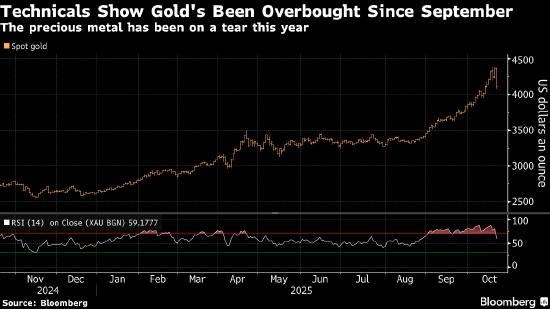
Spot gold prices plummeted as much as 6.3%, their biggest drop in more than 12 years, while spot silver fell as much as 8.7%, after technical indicators suggested the previous rally may have been overdone.
"Today's historic intraday pullback in gold was driven by a confluence of strong technical indicators," said Frank Monkam, head of macro trading at Buffalo Bayou Commodities. He sees strong support in the $4,000-$4,050 range and expects prices to climb again after retreating from overbought levels.
"Position liquidation should set the stage for the next leg higher," he said, with ETFs and emerging market central bank flows leading the charge.
The market plunge has brought a sudden halt to the previous rally. Gold and silver both hit record highs this past week. Gold's surge was largely driven by investor bets that the Federal Reserve will make at least one extraordinary interest rate cut before the end of the year, as well as the so-called "depreciation trade," in which some investors are withdrawing from sovereign bonds and currencies to protect against runaway budget deficits.
Helen Amos, commodities analyst at BMO Capital Markets, said gold's record rally since September has been driven primarily by market trend followers, and such trades "are naturally likely to reverse themselves after a few days of price pullbacks."
A stronger dollar has also dampened the appeal of precious metals. At 3:19 p.m. New York time, gold fell 5.8% to $4,105.30 per ounce, while silver fell 8.4% to $48.05 per ounce.
India, the world's second-largest gold buyer, is in the midst of the Diwali holiday, significantly drying up market liquidity. For the silver market, the recent rally has been, if anything, even more dramatic. Silver not only serves as a store of value but also has industrial applications.
Last week, a historic short squeeze in the London silver market pushed prices above the record set in 1980 during the attempted market manipulation by the Hunt brothers. The London benchmark price, which is higher than the New York futures price, prompted traders to ship metal to London to ease supply constraints. On Tuesday (October 21), warehouses affiliated with the Shanghai Futures Exchange saw their largest single-day silver outflow since February, while New York inventories also declined.
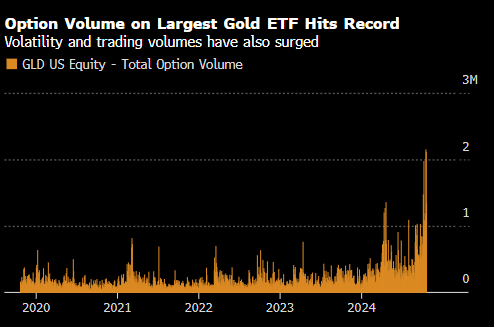
Last week, gold prices hit a new high, driven in part by concerns about credit quality in the U.S. economy. According to data from the World Gold Council, physically-backed gold ETFs saw massive inflows of $8 billion last week, their largest weekly inflow since 2018.
"When you have so much money pouring in quickly, it's natural that there will be some outflows as people take quick profits," said Amos.
With the ongoing US government shutdown, commodity traders have lost one of their most valuable tools: the weekly Commodity Futures Trading Commission report showing the positions held by hedge funds and other institutions in US gold and silver futures. The absence of this data could make it easier for speculators to accumulate unusually large positions in one direction or another.
"The lack of positioning data at this sensitive time could lead to a further accumulation of speculative long exposure in both metals, making them more vulnerable to a pullback," said Ole Hansen, commodities strategist at Saxo Bank.
Gold's rally since 2023 has helped it attract mainstream investors, though they tend to be less committed to trades and more inclined to lock in profits. So-called retail investors have also contributed to the price pullback.
However, the long-term factors that have propelled gold to consecutive record highs, including continued buying by central banks, remain intact, and analysts still expect prices to resume their upward trend in the coming months.
"We like the gold story, and we believe it's a good one from a fundamental perspective," said BMO's Amos. "We forecast prices around $4,500 per ounce next year. Prices don't move in a straight line upward, and some corrections are healthy, so some volatility along the way is inevitable."