
The US government is growing increasingly anxious about the rare earth issue, continuing to pour money into investments, but with limited success.
Seeing this, Western industry representatives are now criticizing the US: "The reason it can't match China is because it's not spending enough."
According to Bloomberg News on October 21, South African mining industry veteran Brian Menell, speaking at the "Resilience Future" forum in London, warned that Western governments are still moving too slowly to secure supplies of lithium, rare earths, and other critical materials. He noted that the US government must outspend China on critical mineral projects to challenge its dominance of the global rare earth supply chain.
Menell is CEO of TechMet. TechMet, a Dublin-based mining investment company, has reportedly received significant financial support from the US government. It specializes in the mining of key metals such as lithium, nickel, cobalt, and rare earth elements needed for the clean energy transition.
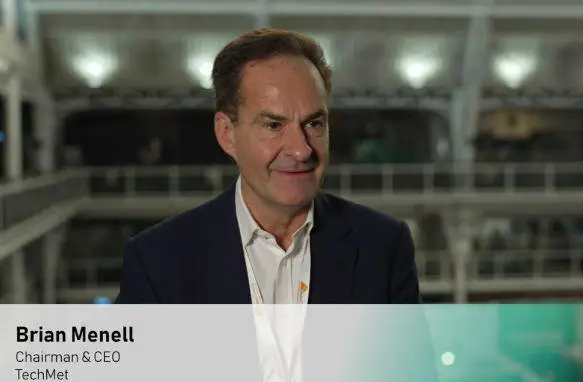
TechMet CEO Menell video screenshot
"We must surpass the Chinese in innovation and surpass the Chinese in funding," Menell said in an interview, arguing that the Trump administration is ready to act. TechMet has received approximately $105 million in financing from the US International Development Finance Corporation.
Menell then praised US President Trump. "A second Trump administration is ready to do new things and move quickly, unconstrained by convention and bureaucracy. We will see larger and more deals, and much more active US government involvement in these supply chains than in the past."
Menell went on to say that expanding critical mineral production capacity requires direct government involvement to reduce risks in early-stage projects and accelerate development. The US and its allies must also rethink how they work with developing countries to safeguard supply chains that enhance Western industrial competitiveness and national security.
He stated, "We must rapidly build capacity to meet future demand, and do so in a way that is free from Chinese control. This means transforming the industry in terms of scale, standards, and independence."
The report mentioned that TechMet, which invests in projects to produce battery metals and rare earth materials, is currently bidding for the Dobra lithium deposit in Ukraine's Kirovohrad region. The project is part of the US-Ukraine Natural Resources Initiative, and the winning bidder must invest a minimum of $179 million.

Graphic by the Financial Times
Rare earths, known as "industrial vitamins," are critical raw materials for strategic industries such as advanced weaponry, aerospace components, wind power, new energy vehicles, robotics, and intelligent manufacturing. For the past 30 years, China has consistently dominated rare earth mining and refining.
According to the International Energy Agency, China accounted for over 60% of global rare earth mineral production in 2023, but controlled 92% of global production in the processing stage, giving it a near-monopoly on global rare earth processing. The US Geological Survey also stated that from 2020 to 2023, 70% of US imports of rare earth compounds and metals came from China.
In April of this year, US President Trump wielded the "tariff stick" globally, imposing so-called "reciprocal tariffs," with tariffs on China reaching as high as 145%. China subsequently retaliated with a series of targeted measures, implementing export controls on key minerals.
Feeling deeply choked, the US and Western countries, while hyping up a "rare earth shortage," have poured money into developing so-called "non-China" supply chains. The US government has invested in domestic mineral mining, but investors have shied away from it, sensing uncertainty. The EU, looking to the moon, has proposed space mining, a move criticized as unrealistic.
Against this backdrop, Australia, with its rich reserves of rare earth minerals, has been viewed as a "village hope" by the US and Western countries. According to reports, on the 20th local time, Trump and Australian Prime Minister Albanese met to enhance the US's access to rare earths and other key minerals.
However, Bloomberg News bluntly stated that industry executives and analysts warn that it will be difficult for the US and Western countries to quickly establish a rare earth refining network that can replace China. The British Broadcasting Corporation (BBC) recently reported that China holds a near-monopoly on global rare earth processing. Marina Zhang, a critical minerals researcher at the University of Technology Sydney, Australia, noted that China has worked hard over the years to achieve global dominance in rare earth processing capabilities, cultivating a vast talent pool in the field and maintaining a research and development network that is years ahead of its competitors.
She noted that while the United States and other countries are investing heavily in developing alternative rare earth supply sources outside of China, they still have a long way to go to achieve this goal. Australia has significant rare earth reserves, but its production infrastructure remains underdeveloped, making processing relatively expensive.
She said: "Even if the United States and all its allies made rare earth processing a national project, I would say it would take at least five years to catch up with China."