
Amazon unveiled a new robotic system on Wednesday (October 22) that can perform multiple tasks simultaneously in its warehouses.
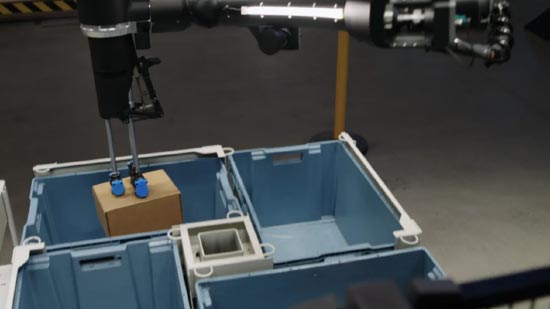
The system, called "Blue Jay," consists of a series of robotic arms suspended on a conveyor-like track, equipped with suction cups at the ends that can pick and sort items of various shapes and sizes.
In a blog post, Amazon said Blue Jay "combines what were previously three separate robotic workstations into a single, efficient unit that can perform picking, sorting, and consolidation operations in a single location."
The company said the goal of this robotic system is to assist employees with previously laborious tasks "while achieving greater efficiency in a smaller physical footprint."
Amazon is currently testing Blue Jay in a South Carolina warehouse. So far, the company has observed that the system can pick, pack, store, and consolidate "approximately 75% of the items stored in the warehouse."
Blue Jay joins Amazon's growing fleet of robotic devices deployed across its warehouses. Over the past few years, Amazon has introduced several robots with diverse capabilities, covering tasks ranging from picking items from shelves to sorting packages. In May of this year, the company also unveiled Vulcan, a robotic system with touch-sensing capabilities.
Amazon's massive push into warehouse automation stems largely from its $775 million acquisition of Kiva Systems in 2012.
The launch of Blue Jay comes amid increasing scrutiny of Amazon's warehouse automation, particularly the impact of the technology on its vast frontline workforce.
A New York Times investigation published on Tuesday (October 21) revealed that Amazon's automation team estimates that the technology could prevent the company from hiring more than 160,000 employees in the United States by 2027, saving the company approximately 30 cents on each item it packs and ships. The New York Times cited interviews and internal strategy documents as the basis for the report.
In response to the report, an Amazon spokesperson said the documents "present an incomplete and misleading picture of our plans."
"In this case, the materials appear to reflect the views of a single team and do not represent our overall current or future hiring strategy across all business lines," the spokesperson said in an email.
Amazon has said that further automation in its warehouses will improve worker safety and reduce injuries, but this claim is disputed. A 2020 report by Reveal, a publication of the Center for Investigative Reporting, showed that Amazon warehouses equipped with robots had higher injury rates than those without automation.
Amazon said last week that it plans to hire 250,000 full- and part-time employees for this holiday shopping season, the same number it has hired over the past two years.
As the second-largest private employer in the United States, Amazon's automation strategy could serve as a bellwether for the broader job market and other businesses. As of the end of the second quarter of this year, Amazon had more than 1.54 million employees worldwide (this figure does not include delivery drivers contracted through third-party companies).
Morgan Stanley analysts estimated in a report released on Wednesday (October 22) that Amazon's deployment of automated warehouses, combined with reduced labor and fulfillment costs, could save the company up to $4 billion by 2027.
Amazon emphasized on Wednesday (October 22) that employees remain at the heart of its robotics research and development. The company said its goal is to "reduce physically demanding tasks, streamline decision-making processes, and create new career opportunities" for employees.
Amazon has consistently emphasized that increased automation in its warehouses will enable employees to take on "higher-value" roles within the company. The company has launched apprenticeship programs in mechatronics and robotics to help employees develop skills in maintaining and monitoring robotic equipment.

Smart Glasses for Delivery Drivers
Amazon also unveiled a pair of augmented reality (AR) glasses for delivery drivers on Wednesday, claiming they can assist drivers with their daily tasks.
Equipped with artificial intelligence, sensors, and cameras, the glasses can scan packages. By overlaying information in the driver's field of view, the glasses can also provide turn-by-turn navigation, hazard warnings, and task reminders. The device can also sound a voice alarm to alert the driver if a dog is present in the customer's residential area.
The system also includes a small controller that attaches to the delivery driver's workwear. The controller features a dedicated emergency button that the driver can use to contact emergency services while on the road.
Amazon said it has tested multiple versions of the glasses with hundreds of drivers, and the feedback from these tests informed the design of the device.
Amazon relies on thousands of contracted delivery companies to get packages to customers' doorsteps. Over the past few years, the company has incorporated more and more technology into its delivery process, including cameras, smartphone apps that track and score driving behavior, and artificial intelligence tools that help drivers identify the package at each delivery point.