
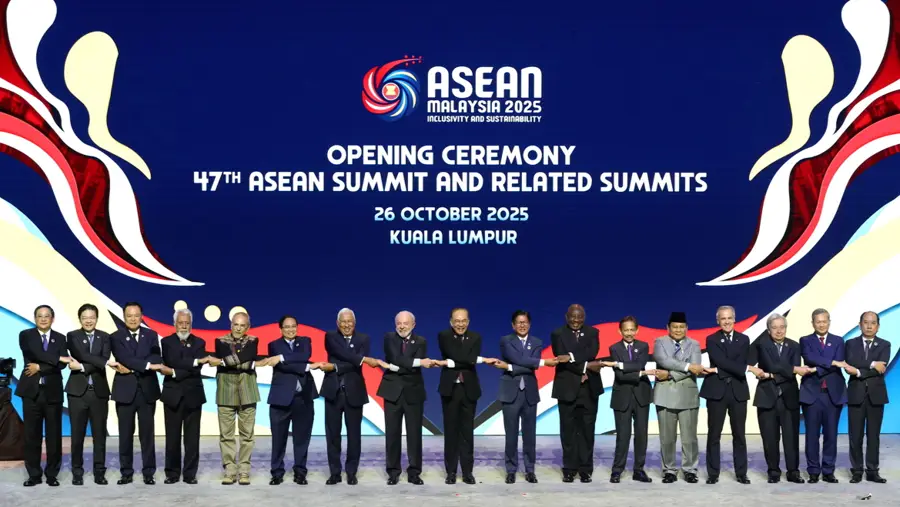
On October 26, guests took a group photo at the opening ceremony of the 47th ASEAN Summit and its series of meetings in Kuala Lumpur, Malaysia.
The 47th ASEAN Summit opened in Kuala Lumpur, Malaysia on October 26. With ASEAN's growing importance in the global economic and political landscape, this summit has attracted worldwide attention. During the three-day summit, ASEAN leaders will focus on topics such as ASEAN Community building and external relations, and discuss deepening regional integration, promoting economic growth, and strengthening ASEAN connectivity.
One of the highlights of the summit was that US President Trump used the summit as his "first Asia-Pacific appearance" since taking office for a second term. Reversing his neglect of the region during his first term, he used the summit platform to engage with leaders from various countries and actively intervene in regional development and security issues.
East Timor Becomes ASEAN's 11th Member
The theme of this summit, "Inclusiveness and Sustainability," demonstrates that maintaining sustainable economic growth amidst a changing international economic landscape remains a common concern for Southeast Asian countries. Tariffs dominated the summit's agenda. Since the Trump administration announced its so-called "reciprocal tariff" policy in April, Southeast Asian countries have expressed concern that their export-oriented economies will be significantly harmed, leading them to lower their economic growth forecasts. After difficult bilateral negotiations, US tariffs on most Southeast Asian countries have still been raised by 10%-20%. Consequently, these countries still hope to secure more tariff exemptions through further negotiations. Furthermore, how to respond to volatile US foreign and economic policies, ensure the stability of global supply chains, continue to benefit their countries, expand trade and political ties, and achieve inclusive development are also issues of common concern to ASEAN countries and the rest of the world.
ASEAN's development is not only closely linked to the external world, but has also faced numerous internal challenges in recent years. The ASEAN Summit officially admitted East Timor as its 11th member, marking ASEAN's first expansion in nearly 30 years. East Timor, which gained independence in 2002, has a population of less than 1.4 million and an economy of approximately $2 billion, making it one of Asia's poorest countries. After 14 years of application and effort, it has finally "realized its dream (of joining the ASEAN)."
East Timor certainly hopes that joining ASEAN will bring greater opportunities for its fragile economy and social development, but this will undoubtedly widen the development gap between ASEAN member states, adding a new challenge to the realization of the ASEAN Community vision. Myanmar's Acting President Min Aung Hlaing's absence from the summit and his ineligibility for next year's ASEAN Chair indicate that the Myanmar issue continues to plague ASEAN. Over the past four years, ASEAN has reached a "five-point consensus" and appointed an ASEAN Special Envoy on Myanmar, but these efforts have been ineffective in alleviating the security and social instability caused by the Myanmar issue, highlighting ASEAN's shortcomings in unity and implementation. The current proliferation of telecom fraud networks in Southeast Asia is also damaging ASEAN's reputation and requires urgent action. Furthermore, the Thai-Cambodian border conflict that broke out in July of this year was the most serious armed conflict between ASEAN member states, a rare occurrence in ASEAN's history. Although the two sides reached a ceasefire agreement within five days thanks to the active mediation of China and Malaysia, the path forward to repairing bilateral relations and achieving lasting peace remains uncertain.
Trump's attendance is a showpiece
Trump's first stop in his second Asia-Pacific term was Kuala Lumpur, Malaysia, this year's ASEAN chair. His primary purpose was to attend the ASEAN Summit, a departure from his regular absences from the summit during his first term and a demonstration of his commitment to regional affairs. At a time when the United States is wielding tariffs globally and its foreign policy is fraught with uncertainty, posing hidden dangers for regional development, Trump's visit is a showpiece.
Witnessing the "peace agreement" reached between Thailand and Cambodia was his first showpiece. Despite a ceasefire reached in July, violations by both sides have continued, resulting in dozens of deaths and the displacement of approximately 300,000 people. Trump's threat of additional tariffs has once again forced the two countries to the negotiating table. On the 26th, Cambodia and Thailand signed a joint statement on peace. While Trump hailed the agreement as "historic" and "accomplishing something many thought was impossible," the outside world viewed the signing of the document as more of a photo op for Trump, the result of US diplomatic pressure to "exchange a trade agreement for a ceasefire." Historical differences between the two countries remain. Thailand's foreign minister initially refused to call it a "peace agreement," merely acknowledging it as a "pathway to peace."
Holding numerous meetings with various world leaders was his second major show. The transactional nature of the Trump administration's foreign policy was vividly demonstrated at this summit. At the signing ceremony of the Thai-Cambodian joint peace statement, Trump announced the signing of critical minerals agreements with Thailand and Malaysia. Before meeting with Brazilian President Lula, who was attending the summit for the first time, to discuss issues such as reducing the 50% US tariffs on Brazil, Trump confidently stated, "I think we should be able to make some very good deals for both countries," demonstrating his commitment to this mineral-rich South American nation.
The largest-ever ASEAN Summit not only reflects the international community's widespread recognition of ASEAN's central role in regional affairs, but also underscores the indisputable fact that ASEAN's development and security are inseparable from the broader region and the international community, and that the construction of the ASEAN Community requires external support. Amidst protectionism and anti-globalization, ASEAN must strive to seize more development opportunities, strengthen its strength, and enhance its resilience. This requires ASEAN to diligently explore with "Asian wisdom."