On October 28th, Eastern Time, Nvidia held its GTC conference in Washington, D.C., where CEO Jensen Huang discussed the cutting-edge prospects of the AI industry.
Unlike previous presentations with a clear focus, Jensen Huang's speech this time was very broad, covering all the hot topics in global capital markets: 6G, quantum computing, AI in physics and robotics, nuclear fusion, and autonomous driving.
Facing Nvidia's technology roadmap extending to 2028 and the unveiling of its next-generation Vera Rubin architecture products, coupled with Jensen Huang's boast that "Blackwell and Rubin chip orders have already accumulated to $500 billion by fiscal year 2026," Nvidia's stock price hit a new all-time high, approaching the $5 trillion market capitalization mark, as of the US stock market close on October 28th (Eastern Time).
Chip Shipments Surge, Capacity Expansion Rapidly
Jensen Huang revealed that Nvidia's fastest AI chip, the Blackwell GPU, has achieved full-scale production in Arizona.
Jensen Huang disclosed astonishing chip shipment figures for Nvidia. He stated that Nvidia expects to ship 20 million Blackwell chips. In comparison, the previous generation Hopper architecture chip only shipped 4 million units throughout its entire lifecycle.
Jensen Huang also stated that 6 million Blackwell GPUs have been shipped in the past four quarters, and demand remains strong. Nvidia expects Blackwell and the Rubin chip launching next year to generate a combined $500 billion in GPU sales over five quarters. Earlier this month, Nvidia and TSMC announced that the first batch of Blackwell wafers had been manufactured at their Phoenix, Arizona factory. Nvidia stated in a video that Blackwell-based systems will now also be assembled in the United States.
Nvidia Partners with Nokia for 6G Networks
As its first officially announced collaboration, Jensen Huang announced a partnership with Nokia. In addition to a $1 billion equity investment, the two companies will collaborate to launch NVIDIA ARC (Aerial RAN Computer), a 6G-oriented telecom computing platform, capturing opportunities in the AI-RAN market. NVIDIA Arc is a wireless communication system running on CUDA-X.
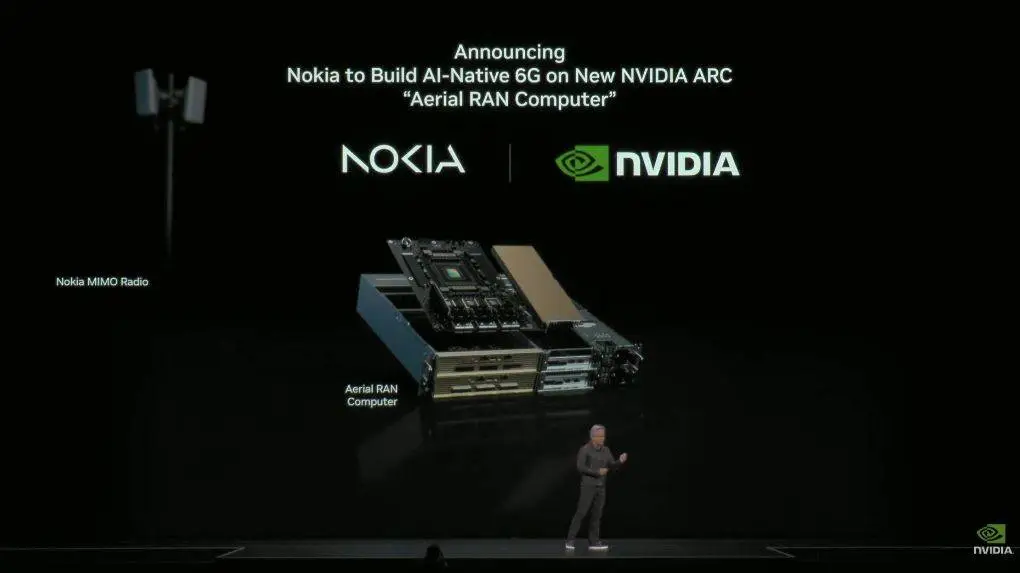
Nvidia stated that "AI traffic" is currently experiencing explosive growth. For example, of ChatGPT's 800 million weekly active users, nearly 50% access AI via mobile devices. With AI-RAN systems, mobile operators can improve performance and efficiency, enhance the network experience for AI applications, and provide 6G services using the same infrastructure, providing network connectivity for drones, cars, robots, and AI glasses.
In a press release following the event, NVIDIA also announced a partnership with T-Mobile, Cisco, and other partners to create the US's first AI-native wireless stack for 6G, and launched new applications to advance next-generation wireless technologies.
NVQLink Connects Quantum Computing and GPU Systems
NVIDIA also showcased NVQLink, built on CUDA-Q cores, designed to connect traditional GPUs and quantum computers to accelerate quantum computing. Current quantum computing is highly sensitive to environmental noise and has limited availability. Therefore, GPU-based supercomputers are needed to handle part of the workload of quantum processors and support the control algorithms required for quantum error correction.
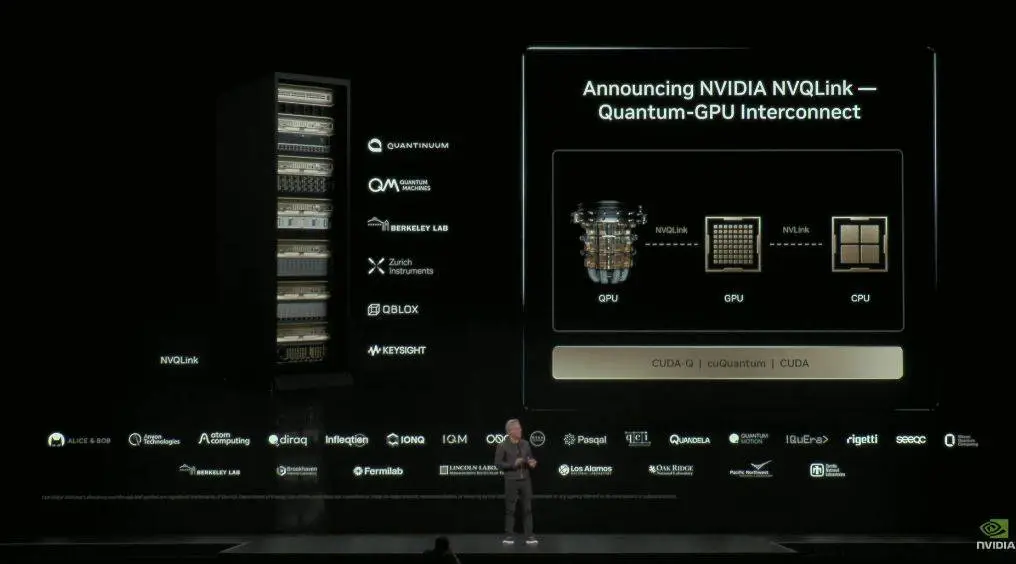
NVIDIA stated that NVQLink technology has already garnered support from 17 quantum processor manufacturers and 5 controller manufacturers, including Alice & Bob, Atom Computing, IonQ, IQM Quantum Computers, Quantum, and Rigetti. Nine national laboratories led by the US Department of Energy will use NVQLink to drive breakthroughs in quantum computing, including Brookhaven National Laboratory, Fermilab, and Los Alamos National Laboratory (LANL).
Nvidia stated that developers can access NVQLink through the CUDA-Q software platform to create and test applications that seamlessly utilize CPUs, GPUs, and quantum processors.
Nvidia and Oracle to Build the US Department of Energy's Largest AI Supercomputer
Jensen Huang also announced an agreement with the US Department of Energy to build seven more supercomputers. These supercomputers will use Blackwell and next-generation Vera Rubin architecture chips, and will be deployed at Argonne National Laboratory and Los Alamos National Laboratory, respectively.
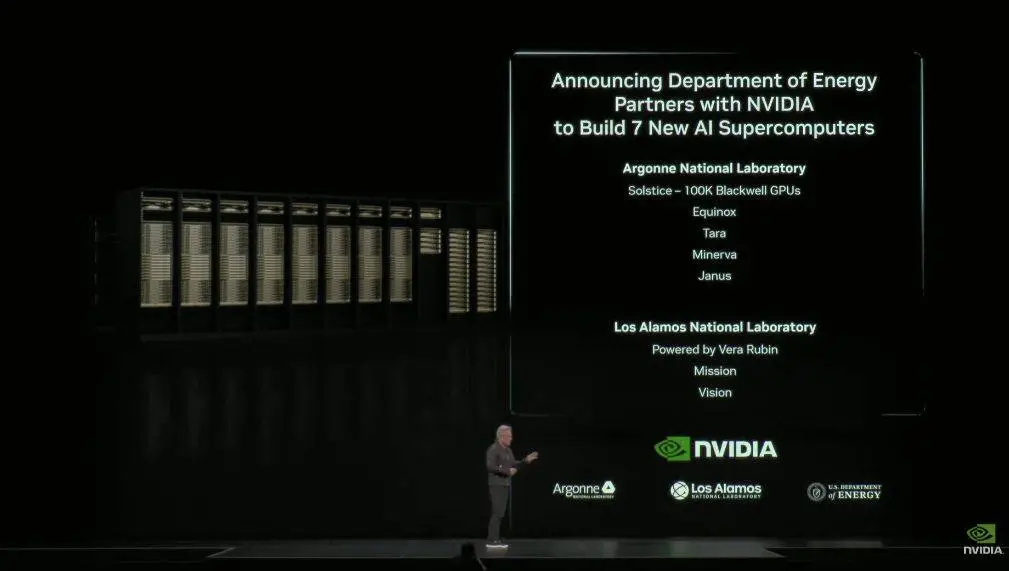
Nvidia announced a collaboration with Oracle to build the US Department of Energy's largest AI supercomputer, the Solstice system, which will be equipped with a record 100,000 Nvidia Blackwell GPUs. Another system, called Equinox, will contain 10,000 Blackwell GPUs and is expected to be operational in the first half of 2026.
Both systems are interconnected via an Nvidia network, providing a total of 2,200 exaflops of AI performance. These supercomputers will enable scientists and researchers to develop and train new cutting-edge models and AI inference models using NVIDIA's Megatron-Core libraries, and scale them using the TensorRT inference software stack.
Energy Secretary Chris Wright stated, "Maintaining U.S. leadership in high-performance computing requires us to build bridges to the next era of computing: accelerating quantum supercomputing. Deep collaboration between our national laboratories, startups, and industry partners like NVIDIA is critical to this mission."
BlueField-4 Drives AI Factory Infrastructure Upgrades
Jensen Huang believes that surrogate AI is no longer just a tool, but an assistant in all human work. The opportunities brought by AI are "countless." NVIDIA plans to build factories dedicated to AI, filled with chips.
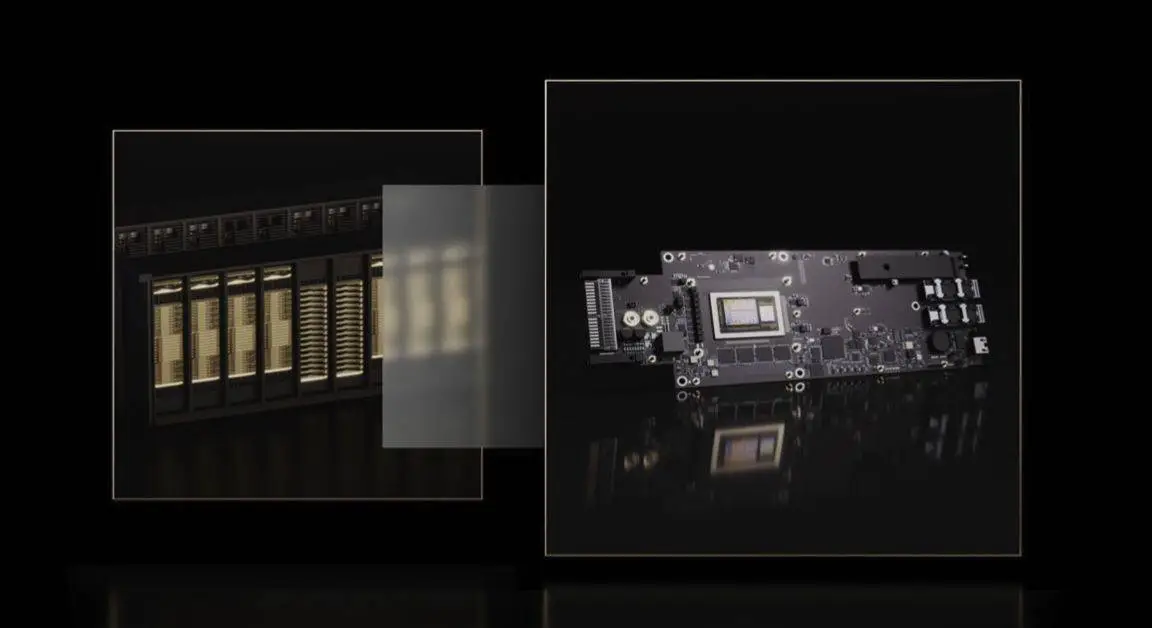
NVIDIA announced the launch of the Bluefield-4 processor, which supports an AI factory operating system.
NVIDIA released the BlueField-4 data processing unit, supporting 800Gb/s throughput, providing breakthrough acceleration for gigabit-scale AI infrastructure. This platform combines NVIDIA Grace CPUs and ConnectX-9 networking technology, offering six times the computing power of BlueField-3 and supporting AI factories scaled up four times.
BlueField-4 is designed for a new class of AI storage platforms, laying the foundation for efficient data processing and breakthrough performance at scale in AI data pipelines. The platform supports multi-tenant networking, fast data access, AI runtime security, and cloud elasticity, and natively supports NVIDIA DOCA microservices.
NVIDIA Partners with CrowdStrike for AI Cybersecurity Development
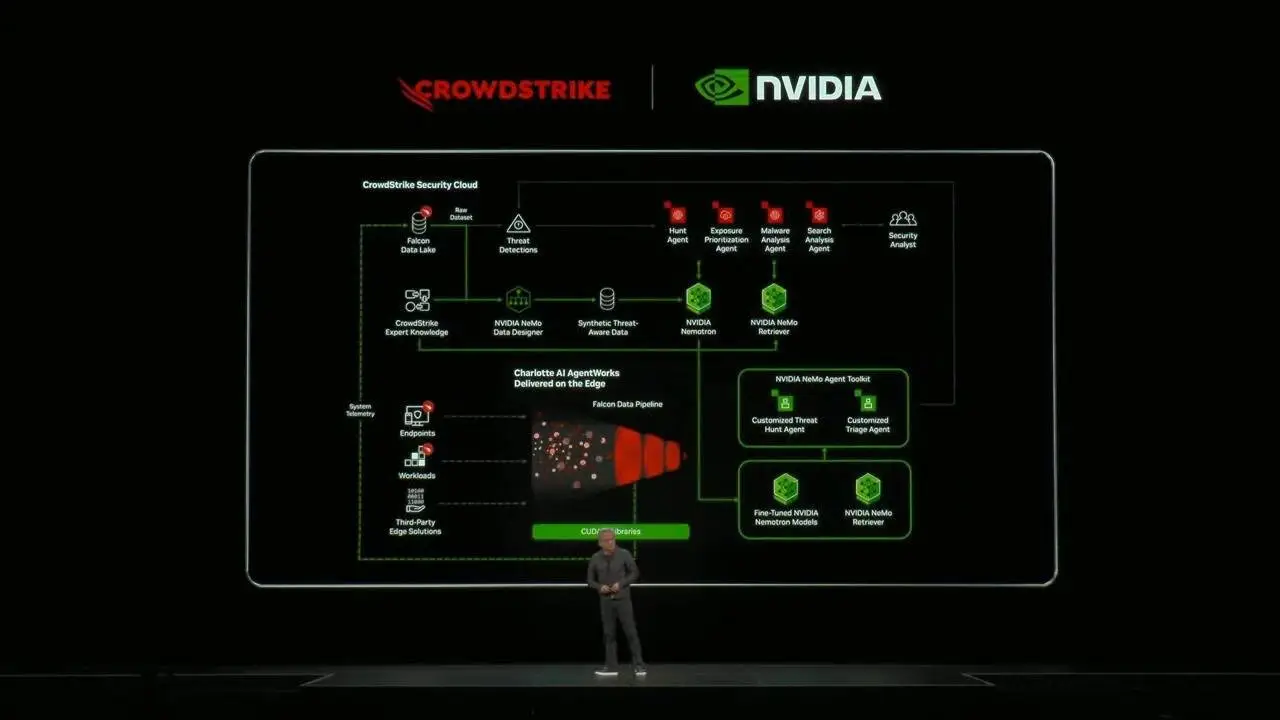
Jensen Huang stated that NVIDIA will collaborate with cybersecurity company CrowdStrike on AI cybersecurity models.
NVIDIA announced a strategic partnership with CrowdStrike to provide NVIDIA AI computing services on the CrowdStrike Falcon XDR platform. This collaboration combines Falcon platform data with NVIDIA GPU-optimized AI pipelines and software, including new NVIDIA NIM microservices, enabling customers to create customized, secure generative AI models.
CrowdStrike will leverage NVIDIA Accelerated Compute, NVIDIA Morpheus, and NIM microservices to bring customized LLM-driven applications to the enterprise. Combined with the unique contextual data of the Falcon platform, customers will be able to address new use cases in specific domains, including processing petabyte-scale logs to improve threat hunting, detecting supply chain attacks, identifying anomalies in user behavior, and proactively defending against emerging vulnerabilities.
NVIDIA's New Autonomous Driving Development Platform Helps Uber Deploy Robotaxi Fleet
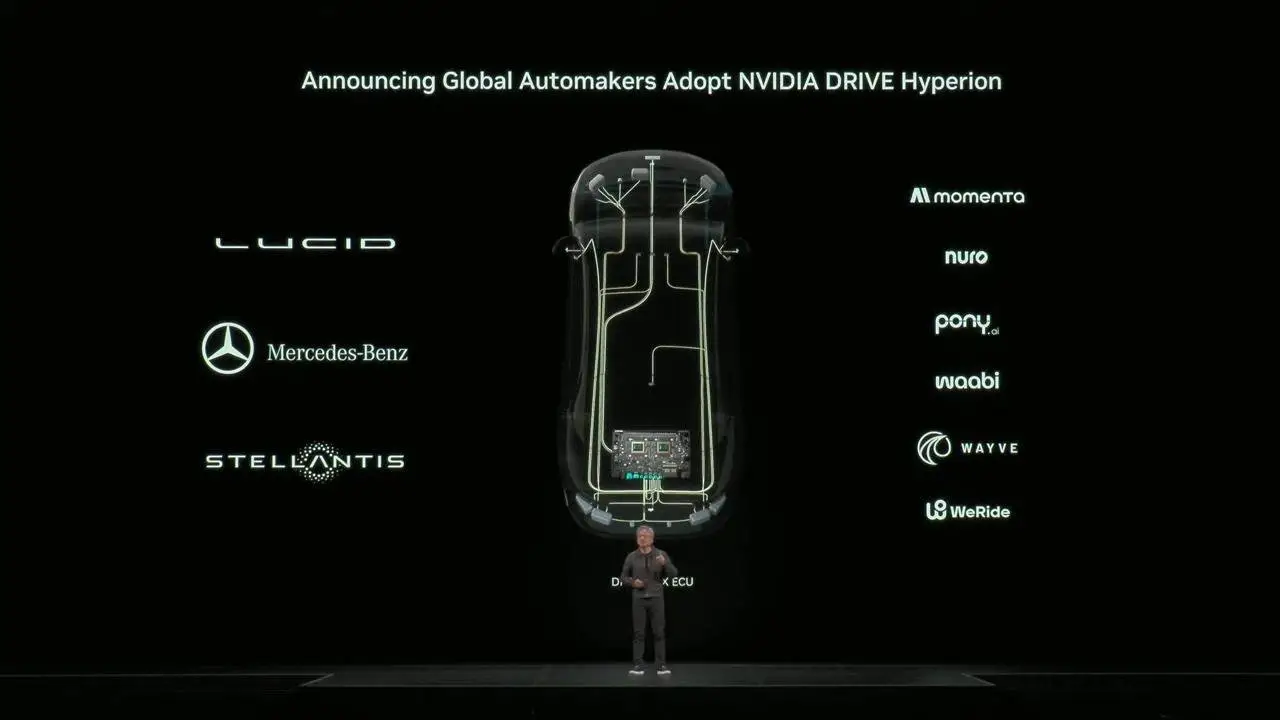
Jensen Huang introduced that NVIDIA's end-to-end autonomous driving platform, DRIVE Hyperion, is ready to launch vehicles providing Robotaxi services. Global automakers, including Stellantis, Lucid, and Mercedes-Benz, will leverage NVIDIA's new technology platform, DRIVE AGX Hyperion 10 architecture, to accelerate the development of autonomous driving technology.
NVIDIA Announces Partnership with Uber to Expand the World's Largest Level 4 Mobility Network Using the Next-Generation NVIDIA DRIVE AGX Hyperion 10 Autonomous Driving Development Platform and DRIVE AV Software. Nvidia will support Uber in gradually expanding its global self-driving fleet to 100,000 vehicles starting in 2027.
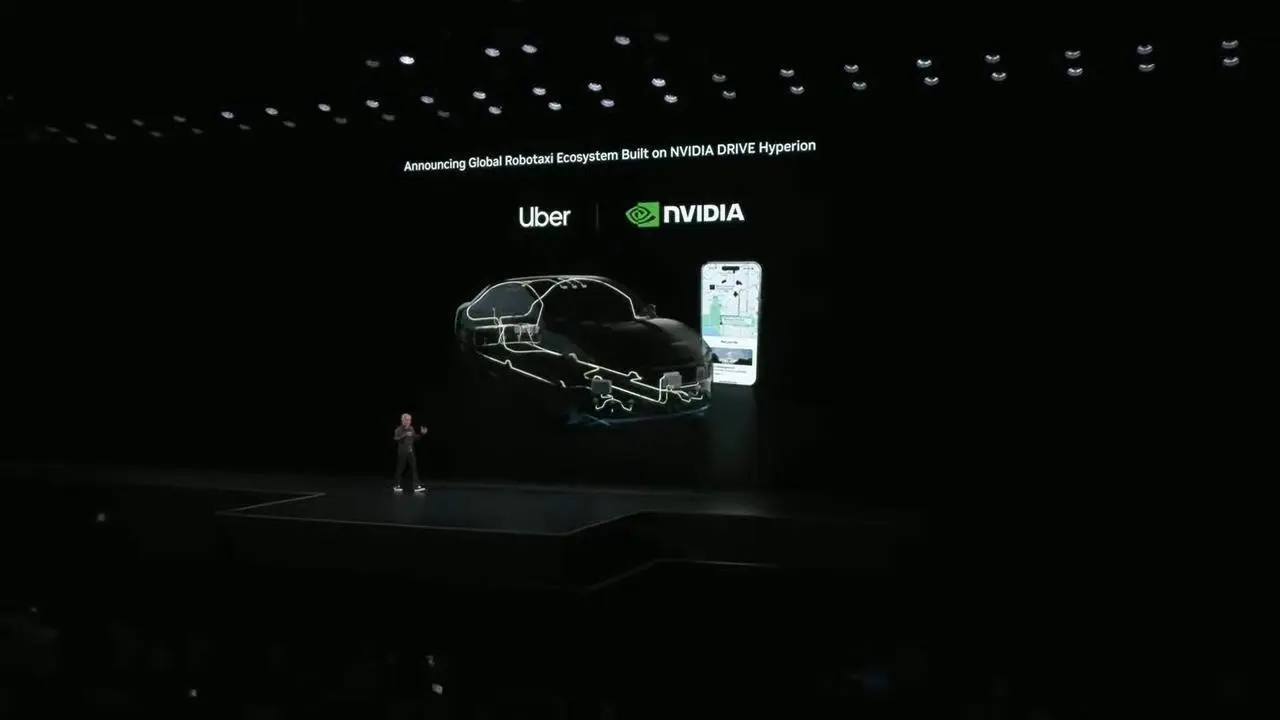
DRIVE AGX Hyperion 10 is a reference-grade production computer and sensor architecture that enables any vehicle to reach Level 4 readiness. This platform allows automakers to build cars, trucks, and vans equipped with proven hardware and sensors, and can host any compatible autonomous driving software.
Jensen Huang stated, "Driverless taxis mark the beginning of a global transportation transformation—making transportation safer, cleaner, and more efficient. Together with Uber, we've created a framework for the entire industry to deploy autonomous vehicle fleets at scale."
Uber CEO Dara Khosrowshahi stated, "NVIDIA is a pillar of the AI era and is now fully leveraging this innovation to unleash Level 4 autonomous driving capabilities at massive scale."
NVIDIA and Palantir Build Operational AI Technology Stack: Lowe's First to Apply Supply Chain Optimization Solutions
The core of the collaboration between NVIDIA and Palantir is integrating NVIDIA's GPU-accelerated computing, open-source models, and data processing capabilities into the Palantir AI Platform (AIP)'s Ontology system. Ontology creates a digital replica of the enterprise by organizing complex data and logic into interconnected virtual objects, links, and actions, providing the foundation for AI-driven business process automation.
Jensen Huang stated, "Palantir and NVIDIA share a common vision: to put AI into action and transform enterprise data into decision intelligence. By combining Palantir's powerful AI-driven platform with NVIDIA's CUDA-X accelerated computing and Nemotron open-source AI models, we are building a next-generation engine to power specialized AI applications and agents running the world's most complex industrial and operational pipelines."
NVIDIA and Palantir also plan to integrate NVIDIA's Blackwell architecture into Palantir AIPs to accelerate the end-to-end AI pipeline, from data processing and analytics to model development, fine-tuning, and production AI. Enterprises will be able to run AIPs in NVIDIA AI factories for optimized acceleration. Palantir AIPs will also be supported in NVIDIA's newly launched government AI factory reference design.
NVIDIA's GPU Roadmap to 2028 Revealed
Jensen Huang also showcased NVIDIA's GPU roadmap to 2028 and a prototype of the next-generation Vera Rubin architecture chip. This product may not be available for mass production and shipping until this time next year or later. IMG8
NVIDIA's liquid-cooled AI server racks were also showcased at the event. Jensen Huang gestured that a 1-gigawatt data center requires 8,000 such racks. A single rack weighs 2 tons and consists of 1.5 million parts.
Accelerating Next-Generation Humanoid Robot Development
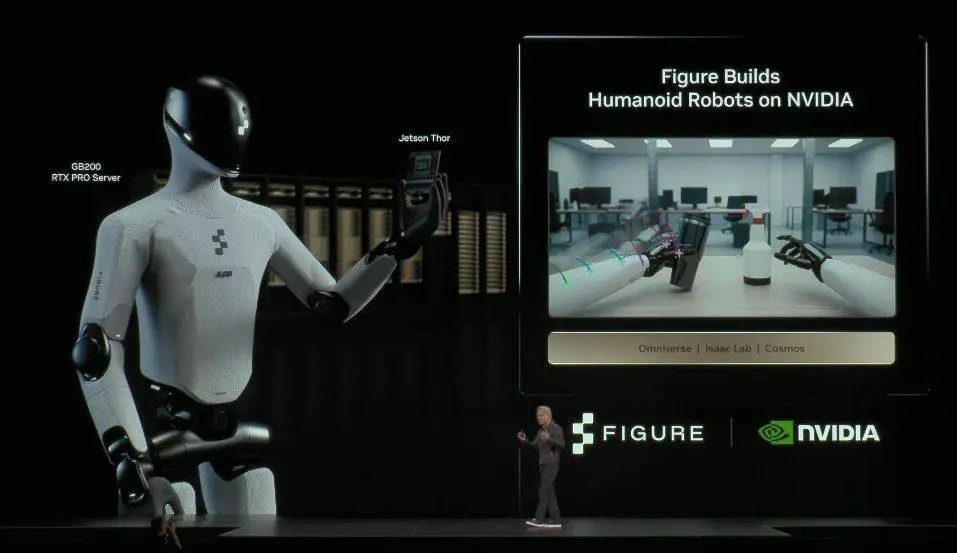
Regarding the highly anticipated "physical AI," Jensen Huang's presentation focused on Omniverse digital twin technology, including its use in building modern factories and training and creating robots. Robotics startup Figure announced a collaboration with NVIDIA to accelerate the development of next-generation humanoid robots. Figure is using NVIDIA's accelerated computing to build its Helix vision-language-motion model and employing the Isaac platform for simulation and training.
NVIDIA Launches Next-Generation Industrial-Grade Edge AI Platform IGX Thor
NVIDIA also launched its next-generation industrial-grade edge AI platform, IGX Thor, designed to bring real-time physical artificial intelligence to the edge. Compared to its predecessor, IGX Orin, IGX Thor offers 8x AI computing power in its integrated GPU form factor and 2.5x computing power in its discrete GPU form factor, while also providing double the connectivity, enabling seamless operation of large language and visual language models at the edge.
Incidentally, nuclear fusion reactors can also be simulated using digital twins. NVIDIA revealed that it has collaborated with General Atomics and a range of international partners to create a high-fidelity, AI-driven digital twin fusion reactor with interactive capabilities. This model can predict plasma behavior in seconds.